

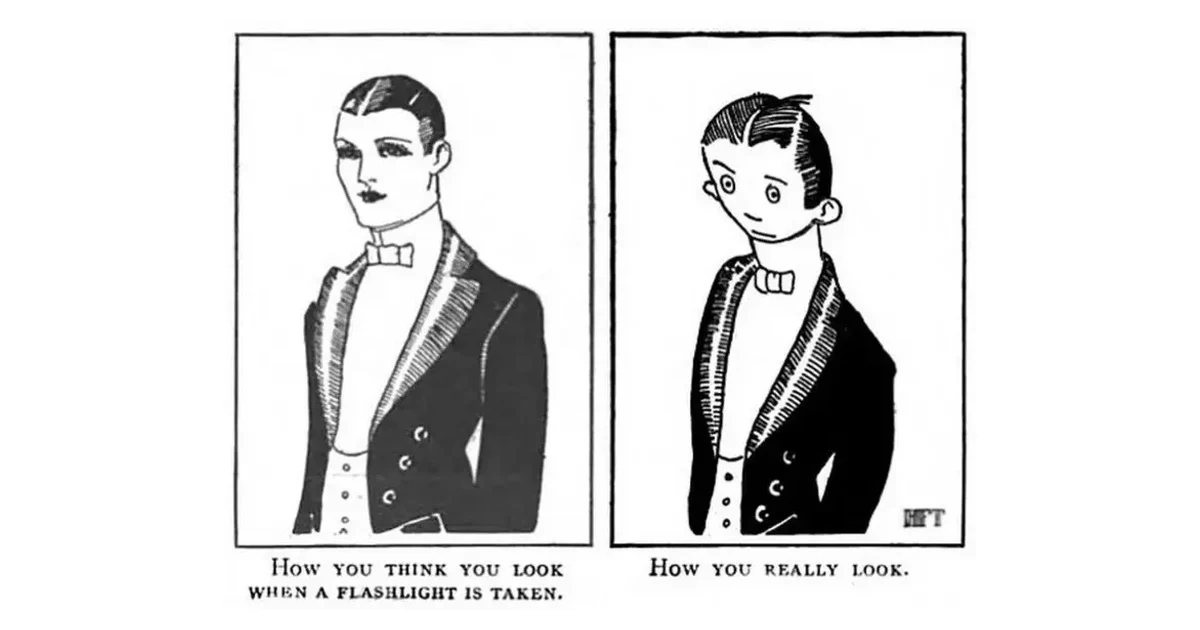
Short answer: The first meme ever is usually said to be a cartoon from 1921: “How you think you look when a flashlight is taken” next to “How you really look.” It’s the oldest known version of the expectation vs. reality meme. The first internet meme is usually the Dancing Baby from 1996. And the word “meme” itself was invented in 1976 by the biologist Richard Dawkins.
The long answer is way funnier. People were making meme-like jokes long before the internet, from Roman wall graffiti to monks drawing knights fighting snails. Here’s the whole story, fact-checked and in order.
What even counts as a meme?
Richard Dawkins came up with the word “meme” in his 1976 book The Selfish Gene. He built it from the Greek mimēma, “something imitated,” and made it sound like “gene” on purpose. For him, a meme was any idea that spreads from person to person by copying: a melody, a catchphrase, a fashion trend.
That’s why “what was the first meme?” has more than one answer:
- Memes in Dawkins’ sense (ideas that get copied) are as old as humans. There’s no first one.
- Memes the way we use the word today are joke formats that people copy and remix with their own twist. That’s where the 1921 cartoon comes in.
- Internet memes are jokes that spread online. They start in the 1980s and 90s.
One rule to keep in mind: a single funny picture isn’t a meme yet. It becomes a meme when other people copy it and change it.
The first meme ever: the 1921 “flashlight” cartoon

In 2018, people on social media rediscovered a cartoon from 1921. On the left, a sharp-looking guy in a tuxedo: “How you think you look when a flashlight is taken.” On the right, the same guy looking like he just woke up from a nap: “How you really look.” Back then, “flashlight” meant a flash photo.
It’s expectation vs. reality, almost a hundred years before Instagram. The cartoon is credited to the Wisconsin Octopus, the student humor magazine of the University of Wisconsin–Madison, which printed it in May 1921. In July 1921, the satirical magazine Judge reprinted it. That’s why you’ll see both names online.
So is it really the first meme? The university’s own archivist said she’s “cautiously optimistic when labeling anything as the first.” And the BBC found another Octopus cartoon that uses the same joke template. Funny enough, that makes the case stronger: the joke was already being copied and remixed. That’s exactly what a meme does.
Memes before the internet
Ancient Rome: the original comment section
Pompeii, the Roman city buried by Mount Vesuvius in 79 AD, is covered in graffiti, and a lot of it reads like a comment section. Some real examples from Roman walls (translations vary a little):
- “On April 19th, I made bread.” The first food blogger.
- “Epaphra, you are bald.” Short. Brutal. Timeless.
- “We have wet the bed. I admit, we were wrong, my host. If you ask ’why?’ There was no chamber pot.” A one-star hotel review, written on the wall of an inn in Pompeii.
- And the best one, found on several walls in Pompeii: “I wonder, O wall, that you have not yet collapsed, so many writers’ clichés do you bear.” Even the Romans were tired of reposts.
Not every Roman joke was harmless, though. The Alexamenos graffito, scratched into a wall in Rome around the 2nd or 3rd century AD, shows a young man next to a crucified figure with a donkey’s head. The caption says “Alexamenos worships his god.” Most historians read it as a mocking picture of a Christian, which makes it one of the oldest known roasts. It’s in the Palatine Museum in Rome today.

The oldest joke book: Philogelos
The ancient Greeks even had a joke book. The Philogelos (“The Laughter-Lover”) probably dates from the 4th century AD and has 264 jokes, some of them repeats or variations. Many star the same characters, like the clueless “scholar” who gets everything wrong. Same characters, same setups, new punchlines. That’s basically a meme format, just over 1,600 years before your FYP.
The Middle Ages: knights vs. snails

In the late 1200s and early 1300s, the artists who decorated handwritten books kept drawing the same weird scene in the margins: a knight in full armor fighting a snail. Art historian Lilian Randall counted 70 of them in 29 manuscripts, most made between 1290 and 1310 in northern France, Flanders and England.
Nobody knows for sure what the joke was. Randall thought the snail stood for a group people back then mocked as cowards. Others think it’s simply a parody: the brave knight, scared of the slowest animal alive. Either way, it’s the same joke, copied again and again by different artists. Total meme behavior.
World War II: Kilroy was here

A bald guy with a long nose peeking over a wall, plus the words “Kilroy was here.” During World War II, American soldiers drew him everywhere they went, and joked that Kilroy had always been there first. The British had their own version, Mr. Chad, who complained about shortages: “Wot, no petrol?”
Who Kilroy was is still a mystery. After the war, more than 40 people claimed to be the real one. A popular theory points to a shipyard inspector named James J. Kilroy who marked the work he had checked. Proven? Not really. Iconic? Absolutely.
The first internet memes
1982: the smiley 🙂
On September 19, 1982, computer scientist Scott Fahlman posted on a message board at Carnegie Mellon University: “I propose that the following character sequence for joke markers: 🙂 Read it sideways.” It’s not a funny picture, but it’s the internet’s first joke marker, and everyone copied it. Not bad for one message.
1990: Godwin’s Law

Lawyer Mike Godwin noticed that online arguments kept ending the same way, so in 1990 he put it into a rule: “As an online discussion grows longer, the probability of a comparison involving Nazis or Hitler approaches one.” He spread it on purpose, as an experiment with memes, because he wanted people to stop making those comparisons so casually. In 1994 he wrote about it in Wired in an article called “Meme, Counter-meme,” an early example of the word “meme” being used for internet culture.
1996: the Dancing Baby

The Dancing Baby started out as a demo file for 3D animation software in 1996. People turned it into a GIF, sent it around by email and made their own versions with different songs. In 1997 and 1998 it showed up in news segments, ads and on the TV show Ally McBeal. When people ask about the first internet meme, this is usually the answer.
1998: the Hampster Dance

A Canadian art student, Deidre LaCarte, built a GeoCities page named after her pet hamster, Hampton. It was full of dancing hamster GIFs, looping a sped-up song from Disney’s Robin Hood. She made it for a contest with her sister and her best friend: who could get the most visitors? The page spread so far that in 2000 an official “Hampsterdance Song” came out as a single.
2001: All your base are belong to us

The line comes from the European version of the video game Zero Wing from 1991, which had a famously bad English translation. Ten years later, in February 2001, a music video remixing the scene went viral on Newgrounds. Soon the phrase was everywhere: on shirts, on signs, in every forum.
2007: LOLcats and Rickrolling
Then came the image macro: a picture with bold text on it, the format most people picture when they hear “meme.” Many trace LOLcats, cat photos with broken English, back to “Caturday” on 4chan. In January 2007 the site I Can Has Cheezburger? started. In May of the same year, Rickrolling was born: a link that promised a trailer for GTA IV but led to Rick Astley’s 1987 song “Never Gonna Give You Up.” Almost 20 years later, people still fall for it.
Today: sounds, templates and AI
Today a meme can be a picture, a sound, a dance or an AI video. The format changed, the idea didn’t: copy it, change it, pass it on. A few recent examples from our blog:
- Hit the road dude: one real clip, endless AI remakes.
- The La Tormenta de Arena trend: a 2010 movie scene, recast with everyone from Batman to cats.
- The James Doakes meme: one stare, a thousand captions.
So, what was the first meme?
It depends on what you count:
- First meme ever, the way we use the word today: the 1921 “flashlight” cartoon, the first known expectation vs. reality meme.
- First internet meme: the Dancing Baby, 1996. Some people count the 1982 smiley.
- Oldest meme-like jokes: Roman graffiti and the Philogelos, around 2,000 years old.
- The word “meme”: Richard Dawkins, 1976.
Humans have always been unserious. We just swapped walls for comment sections.
Want to make the 2026 version of the 1921 classic? “How you think you look” vs. “how you really look” takes about 30 seconds in our free meme maker. No watermark, no sign-up.
FAQ
What was the first meme ever?
Most sources point to a 1921 cartoon from the Wisconsin Octopus, reprinted in Judge: “How you think you look when a flashlight is taken” vs. “How you really look.” It’s the oldest known expectation vs. reality meme.
What was the first internet meme?
Usually the Dancing Baby, a 3D animation from 1996 that spread by email and in chatrooms. If you count text, the smiley 🙂 from 1982 came first.
What is the oldest meme in the world?
If you count meme-like jokes, Roman graffiti like the ones in Pompeii (before 79 AD) and the Alexamenos graffito are among the oldest. As a meme format that people still use today, expectation vs. reality from 1921 is the oldest known one.
Who invented the word “meme”?
The biologist Richard Dawkins, in his 1976 book The Selfish Gene. He based it on the Greek word mimēma, “something imitated.”
When was the first meme made?
That depends on the definition: in 1921 (first known meme format), in 1996 (first viral internet meme), or about 2,000 years ago (Roman graffiti). There’s no single date everyone agrees on.
Moral of the story: memes are older than your great-grandparents. The Romans just didn’t have a share button.
Sources: UW–Madison News, Upworthy, Wikipedia: Meme, Mental Floss, Open Culture, Wikipedia: Alexamenos graffito, Wikipedia: Philogelos, Different Visions, Wikipedia: Kilroy was here, Wikipedia: Emoticon, Wikipedia: Godwin’s law, Wikipedia: Dancing baby, Wikipedia: The Hampsterdance Song, Wikipedia: All your base are belong to us, Wikipedia: Lolcat, Wikipedia: Rickrolling. Featured image: the 1921 cartoon, public domain, via Wikimedia Commons.